
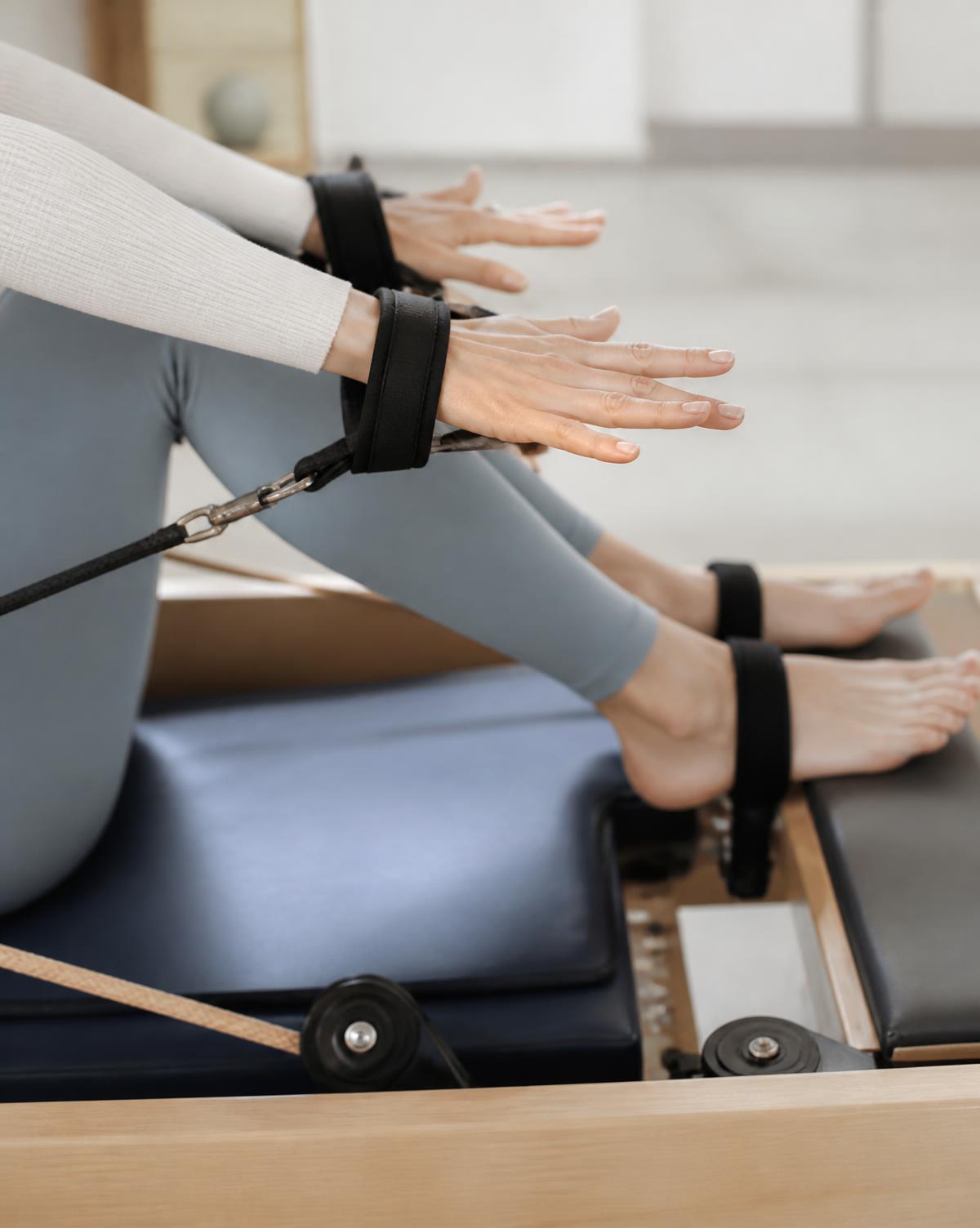
Wear fitted activewear and grip socks, arrive about ten minutes early, and expect a 60-minute session that starts with a short conversation about your body, then breath and alignment work, then spring-loaded strength work, then a calm finish. Most people leave feeling taller rather than exhausted.
What to bring and wear
Fitted activewear is best — leggings or shorts and a top that stays put when you are lying on your back or side. Very loose clothing makes it hard for the instructor to see your alignment, and it can catch on the carriage.
Grip socks are recommended. They keep your feet stable on the foot bar and the carriage. Bring water, and leave jewellery and belts off.
Arriving
Come about ten minutes before your start time. That gives you space to settle, use the bathroom, and tell your instructor anything that matters: a recent injury, a stiff neck, a pregnancy, a surgery, a medication that affects balance. None of it disqualifies you; it simply changes how the session is built.
How the 60 minutes usually run
Every session is shaped around the person on the reformer, but the arc is generally the same:
- A short conversation about how your body feels today.
- Breath and set-up work — finding neutral ribs and pelvis before anything moves.
- Footwork on the foot bar, which warms the legs and teaches you to control the carriage.
- Core, arm and back work through the straps, with springs set for you.
- Side-lying or kneeling work for hips and shoulders.
- A calm finish with stretching and breath.
What you will and won't feel
Reformer work is quiet and precise, so the effort often surprises people: you may be shaking slightly during a movement and still be breathing normally. That trembling is normal — it is the small stabilising muscles being asked to work.
You should never feel sharp pain, pinching in a joint, or numbness. Say so straight away if you do; the spring load or position can be changed on the spot.
The day after a first session, most people notice their deep abdominals, inner thighs and upper back. It usually settles within two days, and it is much milder by the third or fourth session.
Booking your first one
For a first session we suggest 1-on-1, so the instructor can teach the machine and read your body without dividing attention. After that, most clients move into small groups, or mix the two.
You can create an account on this site, pick a time from the schedule, and your spot is held for you.
Common questions
- How long is a session at The Movement Studio?
- Sessions are 60 minutes, both 1-on-1 and group.
- Do I need grip socks for reformer Pilates?
- They are recommended. Grip socks stop your feet sliding on the foot bar and carriage, which makes the work safer and more precise.
- How often should I do reformer Pilates?
- Once a week builds steady progress; twice a week noticeably speeds up strength and mobility changes. Consistency matters more than volume.
- Should my first session be private or a group class?
- A 1-on-1 session is the better first step. You learn the machine, the springs and the breathing with undivided attention, which makes group classes far more useful afterwards.
Ready when you are
Book a reformer session in Floreal
1-on-1 or groups of five, 60 minutes, Mon–Thu 8:00 – 19:30, Fri 8:30 – 17:00 · Sat 8:00 – 12:00.
See the scheduleKeep reading
- Reformer Pilates in Mauritius: what it is and who it's for
What a Pilates reformer actually is, how reformer work differs from mat Pilates and the gym, and the kinds of bodies it suits best.
- 1-on-1 or small group: which reformer session is right for you?
An honest comparison of private and small-group reformer sessions — what each is good at, what they cost, and how to combine them.